Should you choose to get it right on your first application, you may wish to consider Australian CDR Help, famed for its competent and quality APEGS report writing services in every engineering discipline across Canada.
It is during situations such as the CBA writing problems that the Engineers Geoscientists Saskatchewan established this service for the candidates. We are the premier online competency-based assessment service provider in Saskatchewan (Canada).
We are dedicated to giving applicants the best possible help for their success in the competency-based assessments, and in return, providing them a chance to avail themselves of such a service at reasonable costs. Our competent and professional writers prepare competency reports aligning rigorously with all guidelines and standards given by APEGS.
APEGS Report Writing: Things to Consider
When writing an APEGS Competency-Based Assessment report, an in-depth description of your engineering experiences must be given; this description must include very specific examples that demonstrate the attainment of 34 competencies under 7 categories. It is best to keep your examples simple, measurable, and oriented toward your inputs.
We have APEGS CBA report writing that will take you one step CLOSER to becoming an Engineer Registered in Canada!
Employment Pre-Conditions and Authoring Methodology
1. Use STAR for Each Instance.
In every competency-based example, every instance of competencies has to be treated through STAR, creating a very clear and concise narrative
- SITUATION: Give a brief description of the overall setting of the project or situation.
- TASK: Relate the actual role and responsibilities.
- ACTION: Specify what actions you actually did, using action verbs like "designed", "analyzed", "developed".
- OUTCOME: Specify the consequences of your actions, detailing them as far as possible quantitatively (i.e., reduced project cost by 15%).
2. Master the Competency Framework
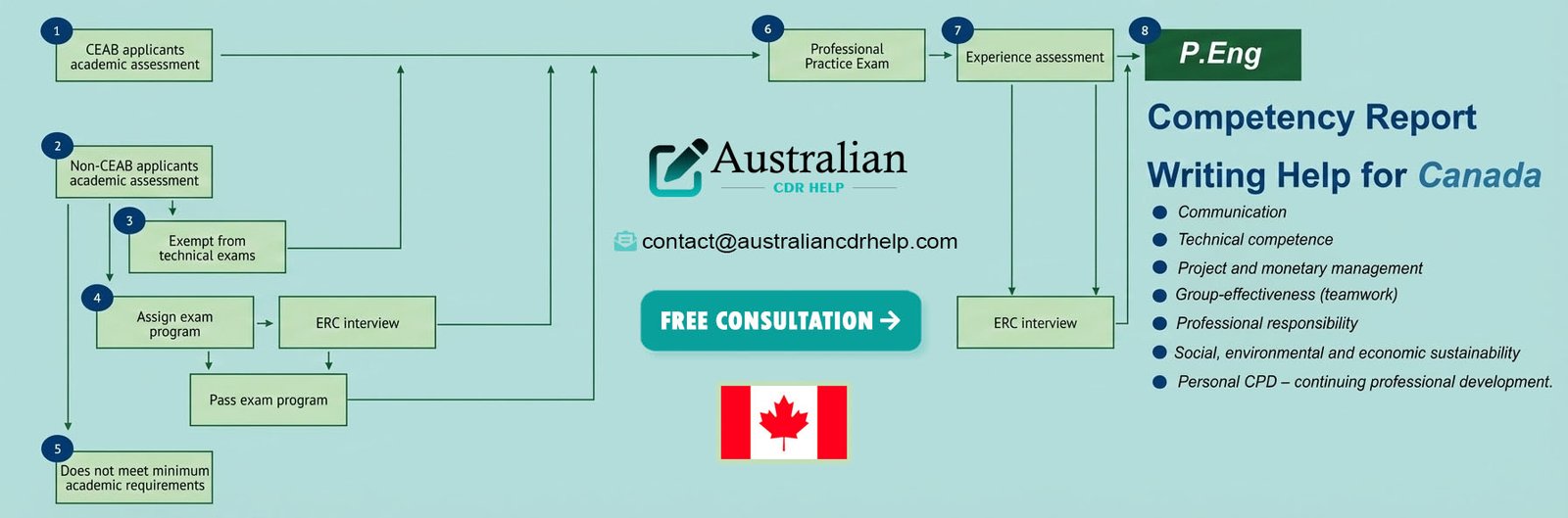
Master the 34 competencies, divided into these seven broad categories:
- Technical Competence: Apply engineering knowledge and tools.
- Communication: Describe how you communicate technically
- Project and Financial Management: Demonstrate how you apply project resource, budget, and schedule management.
- Team Effectiveness: Show your ability to function as a team member working on projects with colleagues.
- Professional Accountability: Give examples of ethical behaviour and ethical decisions.
- Social, Economic, Environmental, and Sustainability: Describ+e how the greater impacts of your work were taken into consideration.
- Personal CPD: Describe occasions on which you maintained or improved your professional skills.
3. Provide details and personal examples
Oppose generalisations; instead, emphasize your own actions or decisions as well as those taken within your team. The assessors are after your contributions and reasoning.
Avoid: "A new system was designed by our team..."
Use: "I designed the hydraulic components of the new system by calculating flow-rates and pressures..."
4. Be ready for validation.
- Every example must be validated by a validator whose role is to provide verification of the experience. Validators are commonly a licensed P.Eng. or a supervisor. Choose validators who are thoroughly familiar with your work and can discuss many aspects of it in detail.
- Considering Experience from the Canadian Perspective
- Basically, APEGS requires a minimum of 12 months of Canadian experience or the equivalent. Incidents must be considered against the backdrop of Canadian ethical codes and practices for an interpreter.
- Our entire spectrum of APEGS Report writing services takes you one step CLOSER toward becoming a Registered Engineer in Canada! Take action now; do not procrastinate.
Table Showing Competency Categories, Competencies, And Min. Avg. Ratings:-
| Category |
Compete ncies |
Category Name |
Min. Avg. Ratings |
| 1. |
Technical Competence |
10 |
3 |
| 2. |
Communication |
3 |
3 |
| 3. |
Project and financial management |
5 |
2 |
| 4. |
Team effectiveness |
2 |
3 |
| 5. |
Professional accountability |
6 |
3 |
| 6. |
Social, economic, environmental, and sustainability |
5 |
2 |
| 7. |
Personal continuing professional development |
3 |
3 |
Common Mistakes to Avoid
- Being vague: General descriptions lack detailed measures of competence taken by assessors.
- Focusing on technical skills only: Examples for all seven categories of competency should include soft skills such as communication and teamwork.
- Not following STAR format: Reports are difficult, if not impossible, for assessors to apply when there is an unstructured and non-standardized format.
- Ignoring ethics and accountability: APEGS holds said ethical and professional conduct in the highest regard. Ensure that your examples reveal adherence to the ethical framework.
The usual form of errorfalling in the category of typos, grammatical errors, or style in reporting will mar the professional aura of a report. Always remember to proofread.
Make sure your competence assessment is approved by the APEGS.
Select AUSTRALIAN CDR HELP so your precious time and effort are duly respected. In fact, we bear real responsibility for your success in the APEGS assessment! So you can rely on us to provide continuous APEGS writing services in Canada.
What service does the APEGS CBA Report Writing Service provide?
Services offered to assist candidates with engineering or geoscience backgrounds to prepare and perfect the Competency Report, which is a critical step to licensure in Saskatchewan.
Usually, this service would provide for:
- Full competency review: Review of your work history to identify those projects and experiences fulfilling the APEGS competency framework.
- Competency Mapping: A consultant and/or technical writer will associate your work experience and projects with the 34 competencies across seven competency areas, including Technical Competence, Communication, and Professional Accountability.
- Competency narratives writing with the STAR Method: Mostly proficient in the writing of your competency narratives, preferably in the Situation, Task, Action, and Result (STAR) format preferred by APEGS assessors.
- Report format and compliance: Ensuring that your report is properly formatted and meets APEGS submission standards and word limits.
- Validator support: These services will prepare and promote your work through validation with your professional engineering or geoscience reference.
- Feedback and revisions: Usually, you get detailed feedback to allow you time to revise your final report so that it becomes a well-expressed, well-rounded, and convincing document.
- Anti-plagiarism guarantee: Plagiarism is the biggest problem for executive bodies such as APEGs, so any credible service guarantees full originality of every report.
The APEGS Competency-Based Assessment (CBA) is the mandatory method for evaluating the work experience of applicants seeking licensure as Professional Engineers (P.Eng.) or Professional Geoscientists (P.Geo.) in Saskatchewan
Required Competencies
Majorly, in a CBA report, you want to demonstrate your capacity in 34 specific competencies, which fall under seven broad categories:
- Engineering competence has the broadest scope, with ten competencies basically describing your own engineering skills, problem analysis, and quality control realm.
- Technical Competence: 10 technical competences Applying engineering knowledge and tools.
- Communication: Three competencies cover your verbal and written communications.
- Project and Financial Management: Five competencies related to planning, budgeting, and managing engineering projects.
- Team Effectiveness: Two competencies cover respecting colleagues and seeing conflict through mitigation.
- Professional Accountability: Six competencies are discussed concerning professional ethics, the concept of liability, and understanding one's limitations
- Social, Economic, Environmental, and Sustainability: Five competencies cover the social and environmental reach of your craft.
- Personal CPD: Three competencies delve into ongoing professional activities and projections.
What the service requires of you Depending upon what exactly may be requested of you for the writing of the report, one may be asked for: A full resume/CV, one that is detailed A full description of project(s) Name(s) and contact details of your validators (professionals or references) Other certificates relevant to professional development, along with proof of such professional development.
At AustralianCDRHelp, we put everything on the line so that every engineer worldwide can be successful on the Competency-Based Assessment while we do the APEGS reports for them. It is very important for the engineer to go to the Canadian job market with the APEGS report in hand to open new avenues for him/her.
Once the APEGS report is successfully granted and approved, it is an opportunity for the Engineers to prove their credentials to the employers. It is basically an acceptance that the education and experience of the Engineer are duly recognized by a Local Authority in Canada for Practicing Engineering.
Have your report approved by APEGS.
If you want guaranteed success, do not waste your time with unqualified agencies; get in touch with us immediately. The results will be refined, proofread, and checked for plagiarism by our writers. We are offering free consultations to our clients.
Procedure for the APEGS Competency Assessment
Report Membership Application
To take the Competency Assessment, you have to undergo the process of joining APEGS as an Engineer-in-Training (EIT) or a Geoscientist-in-Training (GIT) first. A part of this procedure is submitting your academic transcripts along with other documents that are required for the first test.
Assessment Requirement Determination: APEGS will check your educational credentials and then determine if a Competency Assessment is necessary or not. This is usually the case with people who have received their training abroad or whose qualifications do not meet the standards of either the geosciences or the Canadian Engineering Accreditation Board (CEAB).
Preparing for the Competency Evaluation: If the above case applies to you, then you will be asked to prepare your Competency Assessment Report. The following are parts of it:
Job Experience Documentation: You will be showing your job experience by providing unique examples that depict your skills across various APEGS-defined categories.
The competence categories include application of theory, practical experience, management of engineering and geoscience, communication skills, professionalism, and social implications of engineering and geoscience.
| Applicants |
Applicants do a competency self-assessment utilizing instances drawn from work experience to showcase their level of achievement of each competency. |
| Validators |
Validators analyze the competency self-assessment and provide validation and competence level ratings (on a scale of zero to five) for the instances that applicants have assigned to them. They also give feedback on applicants' readiness for professional registration or licensure. |
| Assessors |
Assessors assess the applicants' competency self-assessment and validator feedback and determine whether the instances provided represent ample evidence of meeting the required level for every competency. They also make recommendations on applicants' readiness for professional registration or licensure. |
Writing the Competency Assessment Report
Gradually put together your report in a manner that demonstrates how your work experience meets the APEGS competency requirements. You are certainly expected to deal with each talent by giving specific examples that demonstrate your skills and interaction. By using certain criteria and recommendations for each category, you are allowed to use APEGS to align your report with the expectations.
Submission and Review: APEGS will receive your full Competency Assessment Report, which you will physically be submitting it. The APEGS reviewers, composed of seasoned geologists or engineers, will scrutinise your paper in detail and then decide if your competency is equal to the proficiency in all fields.
Assessment Results:
- Acceptance: The competency assessment of your Competency Assessment Report by APEGS will be the most important factor determining whether you can start the licensing process, which may include exams or other activities or not.
- In addition, APEGS may also require further evaluation: If APEGS decides that your skills are not up to par, you will have to either take a specific guide or tests, finish your learning in whatever you lack, or provide more information that would be in your favour.
- Final Steps to Licensure: After meeting all of the competency criteria and passing any extra tests or educational requirements, you will become a Professional Engineer or a Professional Geoscientist in Saskatchewan.
Common Issues with the APEGS Competency Assessment Report and How to Solve Them
Processing of the APEGS Competency Assessment Report presents different problems to applicants, as the most affected are those whose requirements are hidden or those with unique educational or professional backgrounds. The subsequent list of common problems is paired with the suggestion of practical solutions to help the applicants:
- Understanding Human Resource Needs: The Dilemma. It is generally an impossible task for applicants to discover what APEGS is precisely after in terms of specific
- The Solution: APEGS' website should be visited, and the APEGS Competency Guidelines should be read thoroughly. Besides that, it is extremely helpful to the participants to visit workshops or attend seminars organised by APEGS or to get the opinion of professionals who have already successfully gone through the process.
- Showing Specific Situations: The Problem. It may very well be that a person has the longest signature periods in painting during which it would be almost impossible to get his/her style's main points out, and still, that very person would be able to give very short, very accurate, and even unforgettable illustrations.
- The Solution: Concentrate on selecting the very rarest instances that clearly and unambiguously point to the concepts of engineering or geoscience that have been used. Plus, the whole thing will get much clearer, and the communication of your examples will be very effective through the STAR (Situation, Task, Action, Result) method.
- Writing and Presentation Ability: The issue. An applicant who cannot come up with fluent academic and persuasive texts is likely to have his/her competencies not demonstrated in the competency file.
- The Solution: A professional editor or mentor, who will base his/her feedback on clarity, language, and relevance, may be hired. Writing workshops and resources can also be of assistance in acquiring the necessary skills for the preparation of your file.
- Judgment and Rejection: a major issue. A person finds it difficult to respond to remarks, praying for more details, what to say in case he or she is completely rejected—that would certainly be very frustrating and hard to comprehend!
- Solution: Treat the comments as a good tool for your improvement. If you want to respond to the comments in detail, then give more examples or explain the existing ones better. In case the criticism is not clear, do not hesitate to ask APEGS for clarification.
- The Issue of Plagiarism: a problem. If the technical inputs or the submitted works contain cases of unintended plagiarism, the competency file will be rejected.
- Solution: Ensure that the work you submit is original and give credit to all the references or sources you have used. Before submission, run your pieces through plagiarism detection systems.
Explore Our Other Services
Common Causes of APEGS Competency Assessment Rejection
In the future, applicants can turn to reasons for the common rejections and thus be able to avoid the mistakes to heighten their acceptance chances. The following is a rundown of the most frequently stated reasons for rejection alongside the tactics for overcoming these drawbacks:
- Give Detailed Justifications: Present real-life narratives that unmask the actual application of abilities.
- Illustrate with Suitable Instances: Verify that the chosen situations show the direct reproduction of each needed skill.
- Organise Your Responses Clearly: Present your responses in a way very similar to the STAR method, structured.
- Uphold the Standards: Show cases where the norms of ethics and professionalism are maintained.
- Check for Compliance: Thoroughly examine each technical aspect to ensure that the document is coherent by reviewing each technical detail thoroughly.
- Monitor your CPD Activities: Keep individual records for each professional development activity and associate them with your skills enhancement.
- Keep Plagiarism at Bay: Run plagiarism scanners whenever it is necessary, be sure that all the content is your own, and cite all the sources properly.
- Instead of risking your assessment to chance, team up with the local quality to secure a favourable result. Let us guide you through expert advice today so that you can be prepared to pass the APEGS Competency Assessment.
Why Should You Make Use of Our Skilled APEGS Competency Assessment Help?
- Expert Guidance: You are presented with this great chance to take advantage of the professionals' vast experience and intellect, who are the ones that have already encountered the same procedure. One-on-one tutoring is what can give you the maximum of your particular skills.
- High Approval Rates: To your good fortune, besides, utilise our trustworthy singing report absolutely.
- Paying Close Attention to Details.
- Your file's entire processing is performed under the strictest criteria to ensure that your record is both genuine and ethical. Efficiency and Support
You will be able to concentrate on your job and save time if you enable us to manage the details of your record.
today, connect with Australian CDR Help, and we will be the ones to lead you to success through the APEGS Competency Assessment!